
Historical Overview
First in the World. Today, we take for granted the various systems of numbered highways across the country and around the world. But, as with anything, it all had to start somewhere, and that somewhere was Wisconsin when it comes to numbered highway systems. By the mid-1910s, the proliferation of "marked" highways was reaching crisis proportions. Countless automobile clubs, tire companies, oil companies and tourist associations erected signs along randomly-chosen routes. Sometimes these routes would veer far from the best or most direct path only to pass through a city which paid a fee to have the marked route run though the center of town. Wisconsin was home to many of these so-called "auto trails."
In 1917, the Wisconsin State Legislature enacted a law which prohibited the marking and posting of any "trails" within the state without prior authorization from the state. By 1919, there was only one such "trail," the Yellowstone Trail, marked within the state. (Various "auto trails" existed in other parts of the country through the mid-1920s, however.) As a replacement for the multitude of marked auto trails, the Wisconsin legislature, under Chapter 175, Laws of 1917, authorized the creation and signing of a numbered highway system, with the State Highway Commission as the overseeing agency.
By late 1917, with all surveys and field reconnaissance completed, the State Highway Commission laid out a system of 5,000 miles of numbered state highways on paper. During one week in May of 1918, all route designation signage was erected and Wisconsin became the first in the world with a signed system of route-numbered highways. Michigan, Wisconsin's neighbor to the east, adopted a similar highway signing plan later in 1918. Since then, every state in the U.S., each Canadian province and almost every foreign nation around the world has laid out similar systems of numbered highways. See the 1955 memo "System of Numbering State Trunk Highways for Guidance of Travelers, Historical Background" for a first-person recounting of how the first routes were numbered!
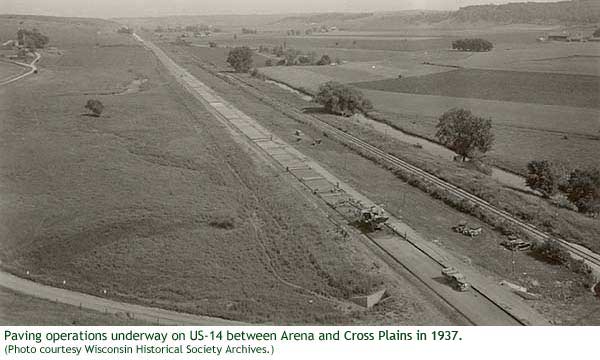
The Middle Years. Although the original system only consisted of 5,000 miles of state-maintained highways, that number was legislatively increased over the years first to 7,500 (1919), then 10,000 (1923), and now to approximately 12,000 miles. In 1926, certain major state highways were redesignated as federal highways when the US Highway system was implemented across all 48 states. Ironically, all of what was then STH-12 was redesignated as US-12! As time passed, the state highway system was refined and improved.
The Interstate Era. Even before the advent of today's modern Interstate Highways, Wisconsin sensed the need for faster, better, high-volume highways. In 1953 the Wisconsin Turnpike Commission was created to study the feasibility of constructing one or more toll roads across the state. The one major proposal was for a toll road to enter the state from Illinois near Genoa City—from a proposed connection with the Illinois Tollway System—and proceed northwesterly via Madison to La Crosse. Various other proposals were studied as well. In 1955 it was decided, though, that a toll road through Wisconsin would not be practical, and that the state should instead fully participate in the proposed National System of Defense and Interstate Highways.
The Interstate Era during the 1960s was the heyday of highway building in Wisconsin. The first Interstate construction began just months after the signing of the Interstate Highway Act into law in 1956 at Goerke's Corners near Waukesha. Intially, the state was to be home to only two mainline Interstate highways, I-90 and I-94, but an early proposal to run an Interstate highway from Milwaukee to Green Bay eventually came to fruition—albeit on a different alignment than that first proposed. The highway department also proposed other Interstates, such as a connection between Milwaukee and Janesville-Beloit, but were turned down by the Federal Highway Administration (FHWA). Unlike other states, though, Wisconsin eventually constructed most of these denied routes as freeways or expressways.
Visit the following sections of the Wisconsin Highways website for a 'continuation' of this overview:
- Wisconsin's Interstates – for more in-depth information on the state's portion of the Interstate Highway System.
- Milwaukee County Freeways – for a review of the epoch struggle in the building of the freeway system in the state's largest city.
- Introduction – for a modern-day look at the Wisconsin State Trunk Highway system.